Running marketing campaigns in the peptide industry requires more than publishing content, investing in advertising, or maintaining an active social media presence. Businesses need a clear direction, a reliable online presence, and a consistent experience across the channels where potential customers interact with their brand. Without these elements, even well-planned Peptide Marketing Campaigns can struggle to deliver meaningful results.
Many businesses invest time and resources in different marketing activities but overlook the foundation supporting those efforts. A poorly structured website, unclear messaging, weak search visibility, or a disconnected user experience can reduce the effectiveness of campaigns before visitors even become enquiries.
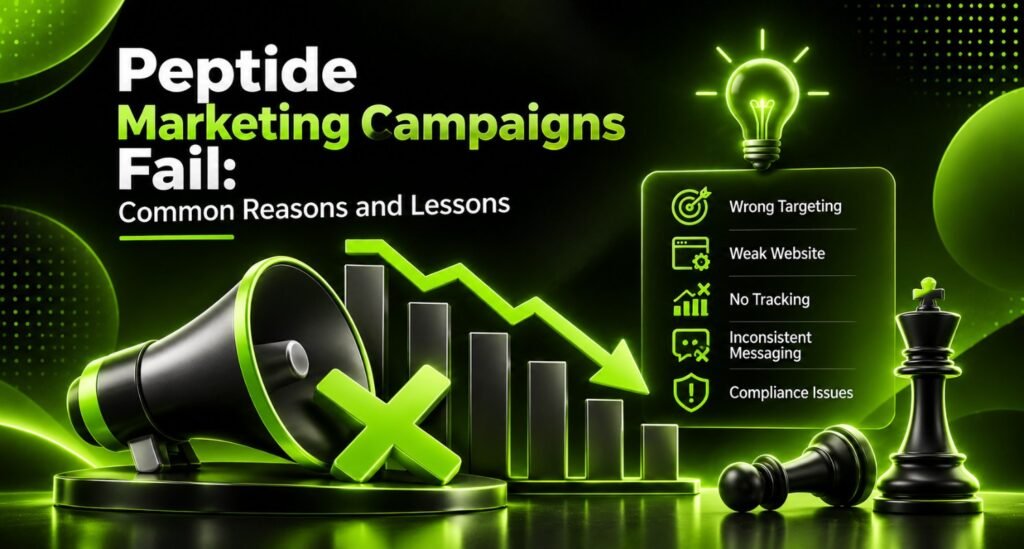
Understanding why Peptide Marketing Campaigns fail helps businesses identify these gaps and make more informed decisions. At AminoWebsites, we recognize the importance of connecting website development, SEO, content, and digital marketing activities to create a stronger online foundation for peptide brands.
Lack of a Clear Marketing Strategy
One of the most common reasons Peptide Marketing Campaigns underperform is the absence of a defined marketing direction. Businesses sometimes launch multiple activities without establishing what they want to achieve, which audience they want to reach, or how each channel supports their objectives.
An effective Peptide Marketing Strategy should begin with a clear understanding of the business, its audience, positioning, and online goals. Without this foundation, marketing activities can become inconsistent and difficult to measure.
A structured plan should identify:
- The target audience and its information needs.
- The brand’s positioning and key messages.
- The purpose of each marketing channel.
- The website pages that support campaign objectives.
- The metrics used to evaluate performance.
A clear direction makes Peptide Business Marketing more organized and helps businesses avoid spending resources on disconnected activities. Instead of treating every campaign as a separate effort, brands can build a consistent approach around shared business goals.
Targeting the Wrong Audience
Even well-designed Peptide Marketing Campaigns can fail when they reach audiences who are not relevant to the business. Broad targeting, unclear audience definitions, and assumptions about customer interests can lead to traffic that does not engage with the website or take meaningful action.
Audience research should consider the business model, product category, market, and the type of information potential visitors are looking for. A company serving research-focused customers, for example, may need a different communication approach from a business operating in another peptide-related category.
Businesses should evaluate:
- Which audience segments are relevant to their offerings.
- What questions visitors have before contacting the company.
- Which search terms bring relevant visitors to the website.
- Whether landing-page content matches audience expectations.
- Which channels are appropriate for reaching the intended market.
A more focused Peptide Advertising Strategy can help businesses make better decisions about messaging, content, and channel selection. It also helps ensure that website content and campaign landing pages address the needs of the people they are intended to reach.
Weak Website Design and User Experience
A marketing campaign does not end when someone clicks a link or visits a website. The website experience plays an important role in determining whether visitors understand the business, explore its offerings, and feel confident taking the next step.
One reason Peptide Marketing Campaigns fail is that businesses invest in attracting visitors without improving the website experience they encounter afterward.
Common website problems include:
- Confusing navigation and page structure.
- Slow-loading pages and poor mobile usability.
- Unclear service or product information.
- Weak calls to action.
- Inconsistent branding and visual presentation.
- Forms that are difficult to find or complete.
A professional peptide website should communicate the business clearly and make important information easy to access. Visitors should be able to understand what the company offers, explore relevant pages, and find appropriate ways to contact the business.
A well-structured website also supports Peptide Lead Generation by creating a clear path from the initial visit to an enquiry. Improving the user experience can make existing traffic more useful without relying entirely on increasing advertising spend.
Poor Landing Page Relevance
Sending campaign visitors to a generic homepage can create unnecessary friction. If an advertisement, email, or social media post promises specific information, the destination page should provide content that matches that expectation.
When landing pages do not align with campaign messaging, visitors may leave without exploring further. This can weaken Peptide Campaign Performance, even when the campaign successfully attracts attention.
Businesses should create relevant landing pages that:
- Match the message and purpose of the campaign.
- Explain the relevant service or offering clearly.
- Include useful supporting information.
- Use visible and relevant calls to action.
- Provide a consistent experience across desktop and mobile devices.
Landing-page relevance is an important part of Peptide Customer Acquisition because it connects audience interest with the next step in the customer journey.
For Peptide Marketing Campaigns to work effectively, the website experience should support the same expectations established by the marketing message.
Ignoring SEO and Organic Visibility
Relying only on paid promotion or social media can limit a business’s ability to attract visitors through search. Organic visibility gives potential customers another way to find relevant information and explore a brand.
A well-planned Peptide SEO Strategy helps businesses organize their website around relevant topics, search intent, and useful content. It can also improve how search engines understand the relationship between different pages.
Common SEO gaps include:
- Missing or poorly optimized page titles and meta descriptions.
- Weak heading structure.
- Thin or repetitive website content.
- Poor internal linking.
- Technical indexing and crawlability issues.
- Missing or incomplete structured data where appropriate.
- Pages that do not address relevant search intent.
Businesses investing in Peptide Digital Marketing should not treat SEO as an isolated activity. Search visibility, website structure, and content quality all contribute to the broader online experience.
A consistent SEO approach can support Peptide Marketing Campaigns by helping relevant audiences find the brand through organic search while strengthening the website’s overall information structure.
Inconsistent Brand Messaging
A brand can lose recognition when its website, social media profiles, advertisements, and other communication channels present different messages. Inconsistent descriptions, visual identity, and tone can make it difficult for visitors to understand what the business represents.
Strong Peptide Brand Marketing requires consistency across the customer journey. The website should communicate the same core positioning that appears in social media content, email communication, and other marketing materials.
Businesses should establish:
- A clear brand description and value proposition.
- Consistent terminology across website pages.
- A recognizable visual identity.
- A professional and appropriate tone of voice.
- Messaging that reflects the business’s actual offerings.
Consistency helps visitors recognize the brand and understand its purpose. It also gives Marketing for Peptide Companies a stronger foundation by ensuring that different marketing activities reinforce rather than contradict one another.
Treating Social Media as a Separate Activity
Maintaining social media profiles does not automatically create a connected marketing presence. Businesses may publish regularly but fail to connect their content with website resources, brand positioning, or broader campaign objectives.
An effective Peptide Social Media Marketing approach should have a defined content direction. Posts should support the brand’s identity, provide relevant information, and guide interested audiences toward useful website pages where appropriate.
Social media planning can include:
- Educational and informational content.
- Company updates and announcements.
- Brand-focused visual content.
- Relevant industry discussions.
- Links to useful website resources.
The objective is not simply to increase posting frequency. It is to make social media a consistent part of the wider marketing experience.
When social media, website content, and SEO support one another, Peptide Marketing Campaigns can benefit from a more connected online presence.
Poor Tracking and Performance Measurement
Another reason Peptide Marketing Campaigns fail is that businesses do not measure the actions visitors take after arriving on their websites. Without reliable tracking, it becomes difficult to understand which channels attract relevant visitors and which pages contribute to enquiries.
Businesses should establish measurement before launching important campaigns. This includes configuring analytics tools, defining conversion events, and checking that tracking works correctly across relevant pages.
Useful measurements may include:
| Area | Metrics to Monitor |
| Organic search | Clicks, impressions, rankings, and organic landing-page traffic |
| Website engagement | Engaged sessions, page views, and user interactions |
| Lead generation | Form submissions, calls, and relevant enquiries |
| Paid campaigns | Spend, clicks, eligible conversions, and cost per result |
| Social media | Reach, engagement, and referral traffic |
| Landing pages | Engagement, form interactions, and conversion rate |
A clear reporting process helps businesses understand Peptide Marketing ROI and identify where improvements are needed.
Tracking should also be reviewed regularly. Incorrect event configurations, missing tags, or incomplete conversion tracking can lead to misleading performance reports. Better measurement makes it easier to evaluate Peptide Campaign Performance and adjust future activities using reliable information.
Overlooking Compliance and Advertising Restrictions
Peptide-related marketing can involve additional considerations depending on the product, intended use, market, and platform. Businesses should not assume that every peptide-related product or claim is eligible for promotion through every advertising channel.
Ignoring these requirements can create serious challenges for campaign planning. Peptide Advertising Challenges may include restrictions on certain product categories, limitations on health-related claims, and platform-specific requirements.
Before launching campaigns, businesses should review:
- Applicable advertising laws and regulations.
- Platform policies for the relevant product category.
- Restrictions on medical or therapeutic claims.
- Requirements for accurate product and business information.
- Geographic limitations and other eligibility conditions.
Peptide Marketing Compliance should be considered before content and campaigns are published, not after an advertisement has been rejected or removed.
A responsible approach to Peptide Paid Advertising involves checking eligibility, preparing accurate messaging, and selecting suitable channels. Platform rules can change, so businesses should review current requirements rather than rely on assumptions.
Choosing Services Without a Connected Plan
Some businesses select individual services without considering how those services work together. They may invest in SEO, social media, website updates, or advertising but lack a clear plan for connecting the results.
A reliable Peptide Marketing Agency should understand how different marketing activities support the wider business. The same applies when evaluating a Peptide Marketing Company or selecting a provider for individual projects.
Businesses comparing Peptide Marketing Services should consider whether the provider understands:
- Website design and user experience.
- Search engine optimization.
- Content planning and website structure.
- Campaign landing pages.
- Analytics and conversion tracking.
- Brand consistency across digital channels.
Effective Peptide Marketing Solutions should address the actual challenges affecting the business rather than simply adding more activities to its marketing calendar.
For companies considering external support, a Peptide Marketing Consultant can also help identify priorities, evaluate existing campaigns, and clarify which improvements should come first.
How AminoWebsites Helps Build a Stronger Digital Foundation
At AminoWebsites, we understand that successful online marketing depends on more than attracting website traffic. Businesses also need a professional website, clear information architecture, useful content, and a user experience that supports their objectives.
Our services focus on helping businesses strengthen the digital foundation behind their marketing activities.
Website Design and Development
A professionally developed website helps communicate the brand’s identity, organize important information, and guide visitors through relevant pages. We focus on website structure, usability, responsive design, and clear navigation.
SEO and Organic Visibility
Our SEO services help businesses improve their website structure, on-page elements, technical foundations, and content organization. These improvements can support long-term search visibility and help relevant audiences find important pages.
Ecommerce Website Development
For businesses with eligible ecommerce operations, a well-organized online store can make product information, navigation, and the browsing experience easier to understand.
Email Marketing and Advertising Support
We also provide email marketing, Google Ads, and Meta Ads services. Advertising opportunities depend on the relevant product, market, and current platform requirements. Campaign planning should always account for applicable restrictions.
Our approach to Peptide Marketing Campaigns begins with understanding the website and the business goals behind each campaign. By improving the digital foundation, businesses can create a more consistent experience for visitors and make better use of their marketing efforts.
If your website is attracting visitors but struggling to generate meaningful enquiries, AminoWebsites can help you identify opportunities to improve its structure, content, and overall experience.
Get a Free Consultation to discuss your website and digital marketing requirements.
Lessons Businesses Can Apply to Improve Campaign Results
Understanding the reasons behind underperforming Peptide Marketing Campaigns is only the first step. Businesses also need a practical process for addressing the issues affecting their online presence.
Some important lessons include:
- Establish clear objectives: Define what each marketing activity should achieve before investing resources.
- Understand the audience: Research relevant search intent, customer questions, and audience requirements.
- Improve website usability: Make important information easy to find and ensure pages work well across devices.
- Connect marketing channels: Align SEO, content, social media, email, and eligible advertising activities.
- Measure meaningful actions: Track relevant enquiries and website interactions instead of focusing only on traffic.
- Review performance regularly: Identify what is working, what needs improvement, and where resources should be focused.
- Maintain responsible communication: Keep website content and campaigns accurate and aligned with applicable requirements.
These lessons help businesses approach Peptide Marketing Campaigns with a more structured process. Rather than repeatedly launching new campaigns to solve existing problems, companies can address the underlying issues that affect their performance.
Build a Stronger Online Presence With AminoWebsites
Marketing results depend on the experience a business creates across its digital channels. Clear messaging, a professional website, relevant content, search visibility, and reliable tracking all contribute to a stronger online presence.
Understanding why Peptide Marketing Campaigns fail allows businesses to identify weaknesses and make improvements based on their actual needs. A well-developed website and connected marketing foundation can help businesses create more consistent visitor experiences and support their wider business objectives.
AminoWebsites helps businesses strengthen their digital presence through website design and development, SEO, ecommerce, email marketing, and advertising services for eligible campaigns.
Ready to improve your website’s marketing foundation? Get a Free Consultation with AminoWebsites and discuss the next steps for your business.
Frequently Asked Questions
Why do peptide marketing campaigns fail?
Peptide marketing campaigns can underperform because of unclear objectives, poor audience targeting, weak website experiences, inconsistent messaging, limited search visibility, insufficient tracking, or advertising restrictions.
How can businesses improve peptide marketing campaigns?
Businesses can improve their campaigns by establishing clear objectives, understanding their audience, optimizing landing pages, strengthening SEO, connecting marketing channels, and measuring meaningful results.
What are the most common peptide marketing mistakes?
Common peptide marketing mistakes include relying on one channel, publishing inconsistent content, ignoring website usability, overlooking conversion tracking, and launching campaigns without reviewing relevant platform policies.
How does SEO help peptide businesses?
SEO helps peptide businesses improve organic search visibility, organize website content, address relevant search intent, and attract visitors who are looking for information related to their business.
Should peptide businesses invest in paid advertising?
Paid advertising may be an option when the relevant product, campaign, market, and platform policies allow it. Businesses should review eligibility requirements before investing in campaigns.
What should businesses look for in a peptide marketing agency?
Businesses should evaluate industry understanding, website and SEO expertise, campaign planning, reporting practices, communication, and the provider’s ability to work within applicable advertising requirements.