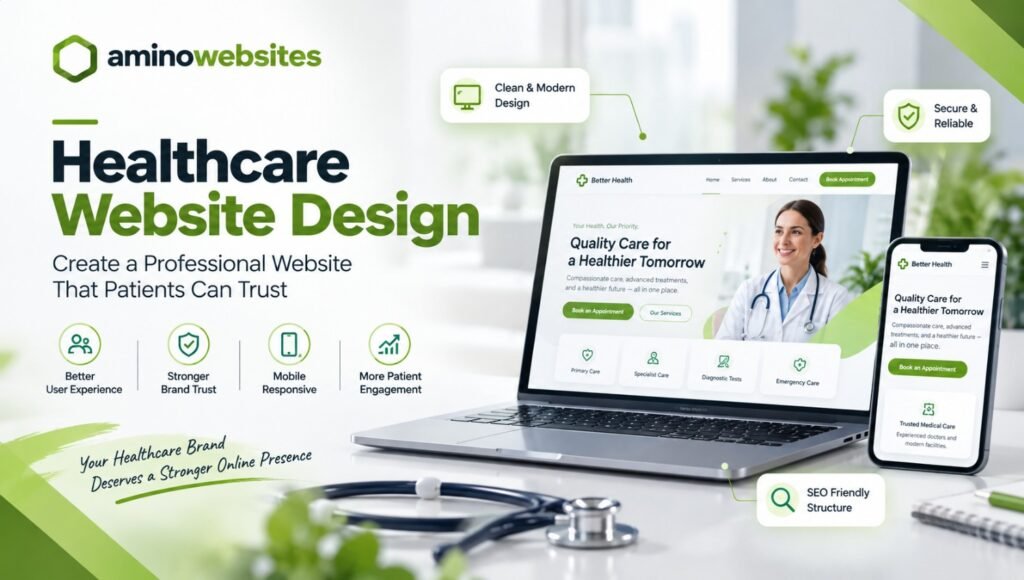
A healthcare website is often the first place a potential patient, healthcare professional, or organization interacts with your brand. Before someone books an appointment, contacts your team, or explores your services, they want to know one thing: can they trust this website? That is why healthcare website design needs to go beyond attractive visuals.
At AminoWebsites, we understand that a healthcare website needs to balance professionalism, usability, accessibility, clear communication, and a strong digital presence. Effective healthcare website design creates an online experience that helps visitors quickly understand your services, find important information, and take the next step with confidence.
A well-planned website can also support marketing, patient engagement, lead generation, and long-term business growth. With the right combination of healthcare web design, content structure, functionality, and performance, your website can become much more than an online brochure.
Why Healthcare Website Design Matters
Healthcare websites operate in an environment where trust and clarity matter enormously. Visitors may be looking for a provider, researching a treatment, checking available services, or trying to contact a healthcare organization.
Poor healthcare website design can make these simple actions frustrating.
A cluttered layout, confusing navigation, slow pages, outdated information, or unclear calls to action can cause visitors to leave before they ever interact with your organization.
Effective healthcare website design focuses on making the entire experience easier.
The website should communicate who you are, what you offer, who you serve, and how visitors can move forward. Every design decision should have a purpose rather than simply making the website look modern.
Create a Strong First Impression With Healthcare Website Design
Your homepage usually creates the first impression of your organization online.
Within a few seconds, visitors should be able to understand what your organization does and why it is relevant to them. Healthcare website design should therefore combine strong visual hierarchy with concise and useful messaging.
A professional homepage can include:
- A clear headline explaining the organization
- Easy-to-find services
- Strong but appropriate calls to action
- Trust-building information
- Simple navigation
- Contact and appointment options
- Supporting information about the organization
The goal is not to overwhelm visitors with information. Instead, healthcare website design should guide them toward the information that matters most.
Build Navigation Around the Visitor
A healthcare website can contain a large amount of information. Services, providers, locations, resources, FAQs, contact details, appointment information, and educational content may all need dedicated sections.
Without thoughtful navigation, this information can quickly become difficult to access.
Good healthcare web design organizes information into a logical structure. Visitors should not have to search through multiple pages just to locate a service or contact option.
A simple navigation system can improve the user experience while also creating a stronger foundation for healthcare website development.
For larger organizations, dropdown menus, service categories, location pages, search functionality, and internal links can help visitors move through the website more efficiently.
Design Service Pages That Answer Real Questions
Service pages are some of the most important pages on a healthcare website.
Visitors often arrive on these pages because they are actively looking for specific information. Healthcare website design should make these pages easy to scan and understand.
Each service page can clearly explain:
- What the service involves
- Who it is intended for
- What visitors can expect
- Important considerations
- Frequently asked questions
- How to contact or book with the organization
This approach makes healthcare website design more informative while reducing unnecessary friction.
Service pages can also support broader website visibility when their content is organized around topics and questions that your audience actually searches for.
Make Healthcare Website Design Mobile-Friendly
Many people access websites through smartphones and tablets. A healthcare website that works well on a desktop but becomes difficult to use on a mobile device can lose potential patients and visitors.
Responsive healthcare website design ensures that pages adapt to different screen sizes.
Buttons should remain easy to tap. Text should be readable. Navigation should work smoothly. Forms should not become difficult to complete. Important contact information should remain accessible.
Mobile usability should not be treated as an optional feature. It should be considered from the beginning of the design process.
Healthcare Website Development and Functionality
Design creates the visual experience, but healthcare website development turns that experience into a functioning website.
A professionally developed healthcare website should be built with performance, flexibility, security, and future growth in mind.
Depending on the organization’s needs, healthcare website development may include:
- Appointment or inquiry forms
- Provider directories
- Service directories
- Location pages
- Search functionality
- Patient resources
- Content management systems
- Third-party integrations
- Custom functionality
- Analytics and tracking
The development process should support the design rather than work against it.
This is where strong healthcare website design and reliable development need to work together.
Build Healthcare Websites With Clear Calls to Action
A website can receive thousands of visitors and still generate few inquiries if visitors do not know what to do next.
Calls to action help solve this problem.
Depending on the organization, the desired action could be:
- Book an appointment
- Contact the organization
- Request information
- Call the office
- Explore a service
- Submit an inquiry
- Schedule a consultation
Healthcare website design should place these actions where they naturally fit within the visitor journey.
A call to action should feel like the logical next step rather than an interruption.
Use Design to Build Trust
Trust is especially important when people are evaluating healthcare-related organizations online.
Visitors want to know that the website represents a legitimate, professional, and reliable organization.
Healthcare website design can support trust through:
- Professional visual presentation
- Clear organization information
- Provider or team information
- Contact details
- Location information
- Helpful educational resources
- Consistent branding
- Transparent communication
- Easy access to important information
The objective is not to fill every page with trust signals. Instead, the website should naturally communicate professionalism throughout the user experience.
Create an Accessible Healthcare Website
Accessibility should be considered throughout the healthcare website design process.
Visitors may interact with your website using different devices, screen sizes, assistive technologies, and browsing preferences.
A more accessible website can include readable typography, sufficient contrast, descriptive links, logical headings, keyboard-friendly navigation, accessible forms, and meaningful alternative text for relevant images.
Accessibility is not simply a technical consideration. It is part of creating a better experience for a wider audience.
Healthcare Web Design Should Support Content
A healthcare website often needs to communicate complex information without making it difficult to understand.
Healthcare web design should therefore provide enough flexibility for educational content, FAQs, resources, service explanations, and organizational information.
Instead of placing large blocks of text on every page, content can be organized using:
- Clear headings
- Short paragraphs
- Helpful subheadings
- Expandable FAQ sections
- Lists where appropriate
- Supporting visuals
- Internal links
This creates a more comfortable reading experience while making important information easier to locate.
Connect Healthcare Website Design With Search Visibility
A beautiful website is valuable, but it also needs to be discoverable.
Healthcare website design and search optimization should work together from the beginning rather than being treated as completely separate processes.
Website architecture, headings, page structure, URLs, internal links, metadata, mobile performance, and content organization can all contribute to a stronger search-friendly foundation.
This is why healthcare website design should consider both the human visitor and the way search engines understand the website.
A search-friendly structure can make it easier for relevant pages to be discovered and understood.
Build a Website That Supports Healthcare Marketing
Your website should not exist separately from your marketing efforts.
It may become the destination for visitors coming from search engines, social media, paid advertising, email campaigns, referrals, and other channels.
Effective healthcare website design creates consistency between these different sources of traffic.
For example, someone clicking an advertisement should land on a page that clearly continues the message they saw in the ad. Someone arriving through search should immediately understand that they are in the right place.
This connection between marketing and healthcare website design can create a more consistent digital experience.
Use Landing Pages for Specific Audiences
Not every visitor has the same needs.
A healthcare organization may serve different patient groups, locations, services, or audiences. Creating dedicated landing pages can make the experience more relevant.
Instead of sending every visitor to the homepage, healthcare website design can direct users toward pages specifically related to their needs.
These pages can have focused messaging, relevant information, appropriate calls to action, and a clear path forward.
This approach can also support paid advertising and other digital marketing campaigns.
Improve Website Performance
Website speed has a direct impact on user experience.
Visitors generally do not want to wait for large images, unnecessary scripts, or poorly optimized pages to load.
Healthcare website design should therefore consider performance during the development process.
Image optimization, efficient code, responsive layouts, caching, lightweight elements, and appropriate hosting can all contribute to a faster experience.
Performance should not be added as an afterthought. Building with performance in mind from the beginning can reduce the need for major improvements later.
Choose the Right Web Design Services
Choosing the right web design services can have a significant impact on the quality of your final website.
A provider should understand more than visual design. They should also consider usability, responsive design, website architecture, content organization, development requirements, performance, and long-term maintenance.
The best website design services are those that connect design decisions with actual business and audience needs.
Before choosing a provider, consider whether they can help with both the creative and technical sides of the project.
Healthcare Website Design Company: What Should You Look For?
Choosing a healthcare website design company requires careful consideration.
Not every design company will approach healthcare websites in the same way. Look for a team that understands how to create professional digital experiences while keeping usability, accessibility, functionality, and business objectives in focus.
A capable healthcare website design company should be able to discuss:
- Website architecture
- User experience
- Responsive design
- Healthcare website development
- Content structure
- Performance
- Conversion paths
- Integrations
- Website maintenance
- Search-friendly foundations
The right partner should be able to explain not only how the website will look, but also how it will function and support your organization.
Website Development Services for Long-Term Growth
A website should not become difficult to manage every time your organization grows.
Professional website development services can create a flexible foundation that allows new pages, services, resources, integrations, and functionality to be added over time.
This is particularly important for organizations that expect their digital presence to expand.
A scalable website reduces the need for constant rebuilding and gives your team more flexibility as requirements change.
Strong healthcare website development should therefore consider both current requirements and future possibilities.
How AminoWebsites Approaches Healthcare Website Design
At AminoWebsites, healthcare website design is approached as a complete digital experience rather than simply a visual project.
The goal is to create websites that look professional, communicate clearly, work smoothly across devices, and provide visitors with an easy path toward the information or action they need.
Our approach can bring together healthcare web design, website development, responsive functionality, content organization, performance, and conversion-focused structure.
Rather than using the same template for every organization, the website should reflect the brand, audience, services, and goals of the business.
AminoWebsites can help organizations build a stronger digital foundation through thoughtful design and development that is prepared for future growth.
Turn Your Website Into a Stronger Digital Experience
The strongest healthcare website design does more than make a website look modern. It helps visitors understand your organization, find information quickly, feel confident in your brand, and take the next step.
When healthcare web design, development, content, accessibility, performance, and marketing work together, the website becomes a much more valuable part of the organization.
If your current website feels outdated, difficult to navigate, slow, or disconnected from your business goals, it may be time to rethink the digital experience.
Ready to build a healthcare website designed around your audience and growth goals? Contact AminoWebsites to discuss your website design and development requirements and create a stronger digital foundation for your organization.
FAQs About Healthcare Website Design
1. Why is healthcare website design important?
Healthcare website design helps create a professional, accessible, and easy-to-use experience that allows visitors to find information and take action confidently.
2. What should a healthcare website include?
A healthcare website can include service pages, provider information, contact details, locations, FAQs, educational resources, forms, and clear calls to action.
3. What is the difference between healthcare web design and healthcare website development?
Healthcare web design focuses primarily on the visual experience and usability, while healthcare website development handles the technical functionality that makes the website work.
4. How can healthcare website design improve user experience?
Clear navigation, readable content, responsive layouts, fast loading times, accessible functionality, and well-placed calls to action can improve the overall experience.
5. How do I choose a healthcare website design company?
Look for a company that understands responsive design, user experience, website development, accessibility, performance, content structure, and your organization’s specific goals.
6. Can healthcare website design support marketing?
Yes. A well-structured website can support traffic from search, social media, advertising, email marketing, referrals, and other digital channels.
7. How often should a healthcare website be updated?
Websites should be reviewed regularly to keep information accurate, maintain performance, improve usability, update technology, and address changing business requirements.