Most advice for new peptide brands focuses on the exciting parts: branding, product photos, launch-day hype. But the things that actually decide whether a research-use-only (RUO) store survives its first year are far less glamorous — and most founders don’t think about them until it’s too late. Age gating that regulators increasingly expect. A signup flow that either protects you or bleeds customers. And conversion tracking that, done wrong, quietly torches your ad budget.
This guide walks through the compliance and technical foundations that separate peptide stores that scale from the ones that get shut down, frozen, or drained. If you’re about to launch, read this before you build — fixing these after the fact is expensive and painful.
Compliance Isn’t a Feature. It’s the Foundation.
Here’s the mindset shift that saves peptide founders the most grief: compliance isn’t something you add to a finished store. It’s the ground the store is built on. Payment processors, regulators, and ad platforms all evaluate RUO brands through a compliance lens first — and if the foundation is shaky, nothing built on top of it is safe.
The trend in peptide regulation is toward more rules, not prohibition, which means the compliance bar only rises from here (our guide on building a compliant peptide store covers the full checklist). Age gates, rigorous COA programs, website compliance, and verification are shifting from “nice to have” to baseline expectations that underwriters and processors look for. Founders who build these in from day one position themselves to benefit as the market matures; those who cut corners get squeezed out as standards tighten.
The rest of this guide covers three foundations new founders most often get wrong.
1. Age Gating: Build It Now, Because It’s Coming
If your plan is a simple “Are you 18+?” popup — or no gate at all — you’re already behind where the market is heading.
Age verification requirements have expanded dramatically. As of early 2026, roughly half of U.S. states mandate some form of age gating, and the laws keep spreading. For supplements specifically, the direction is unmistakable: New York’s law restricting sale of weight-loss and muscle-building supplements to anyone under 18 took effect in April 2025, and other major states are considering similar bills. Notably, this can apply even to products labeled “not for human consumption.”
For RUO peptide brands, age verification does double duty. It’s part of operating within the research-use framework in the first place — suppliers require age verification and research acknowledgment to confirm purchasers understand the compounds are for laboratory use only, not personal consumption. And it’s a signal to your payment processor. As one high-risk payments specialist put it, age gates are not optional theater — they’re evidence underwriters file next to your COAs.
The practical takeaway: build proper age/intent gating into your store from launch, even if it isn’t strictly mandatory in every state you sell to yet. It will be soon, and retrofitting it later — after you’ve built traffic and habits around an ungated flow — is far more disruptive than starting with it. A well-built gate confirms age and research intent without wrecking the user experience, which brings us to the next point.
2. Reduce Signup Friction — Without Cutting Corners
Here’s the tension every peptide store has to resolve: compliance adds steps, and steps cost conversions. Age gates, research-use acknowledgments, account creation — each one is a moment where a potential customer can drop off. The goal isn’t to remove these safeguards; it’s to make them as frictionless as possible so they protect you without killing your sales.
New founders routinely get this wrong in one of two directions. Some bolt on clunky, off-the-shelf verification plugins that break the checkout, add confusing extra pages, or force account creation before someone can even browse — and watch their conversion rate crater. Others strip friction so aggressively that they gut the compliance safeguards they actually need.
The fix is thoughtful design, not a plugin dumped on top of a generic theme:
- Gate at the right moment — verify age and intent where it’s needed, not as an aggressive wall the instant someone lands.
- Keep the acknowledgment clear and single-step rather than a multi-page ordeal.
- Minimize required fields at signup and checkout; every unnecessary field is a lost order.
- Remember returning visitors so they aren’t re-verifying on every visit.
Done right, compliance and conversion stop fighting each other. A clean, purpose-built peptide store integrates the gating and signup flow into the design so it feels like part of the experience — not an obstacle course bolted on at the end.
3. Tracking: Do It Wrong and It Kills Your Ad Spend
This is the one that catches nearly every new founder by surprise, and it’s the most expensive. If you plan to run any paid traffic, how you track and report conversions isn’t a technical afterthought — it directly determines whether your ad spend works or evaporates.
Peptide advertising on Meta is heavily restricted, and enforcement got dramatically stricter in 2026. Supplements are one of the most scrutinized categories on the platform: over 64% of supplement accounts were reviewed at least once in Q1 2026 — a 41% jump over the prior quarter. And the review system is no longer a simple keyword filter. Meta’s 2026 enforcement uses multimodal review that analyzes text, images, and landing pages simultaneously — with semantic understanding that detects synonyms and euphemisms for banned terms, not just exact keyword matches. It scrutinizes your landing page as hard as your ad, and even an ad that passes can be retroactively rejected based on the page it points to.
Because targeting and messaging are so constrained in this niche, the signals you send back to Meta carry more weight than ever. Meta has also tightened the tracking side directly: health and wellness brands now face partial or full restrictions on optimizing campaigns around certain lower-funnel conversion events like sales or appointment bookings. If your events are misconfigured, mismatched, or blocked, Meta optimizes toward the wrong people — or gets no usable feedback at all — and your budget burns with nothing to show for it.
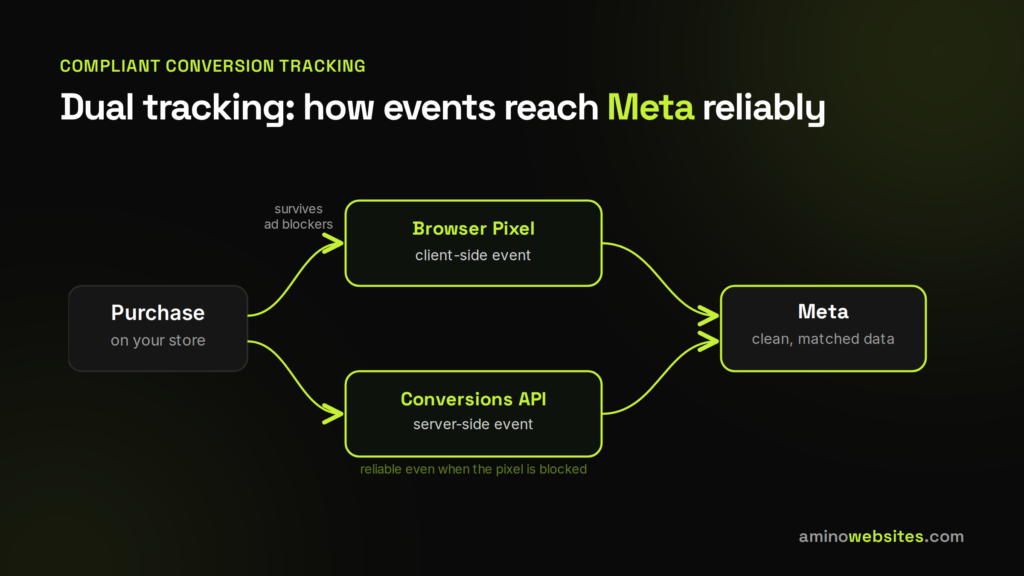
The fix is getting your server-side tracking right. Server-side, first-party tracking helps ensure Meta still receives reliable feedback signals even when targeting and messaging are constrained. In practice that means implementing the Conversions API (server-side event tracking) properly alongside the browser pixel, making sure events are named and matched correctly, and firing them on the actions that matter — so the platform learns from clean data instead of noise. Wrong tracking doesn’t just underperform; it actively misdirects spend. In a niche where every ad dollar is hard-won, that’s the difference between a campaign that scales and one that quietly drains your account.
This is also why the framing of your whole funnel matters. Meta now requires health-adjacent ads to keep claims high-level and, for supplements, to include disclaimers in the ad copy itself — so the compliant, research-first positioning you build into the site is the same thing that keeps your ads and tracking alive.
Putting It Together
Notice how tightly these three foundations interlock. Proper age gating satisfies regulators and reassures your payment processor. A low-friction, well-designed signup flow keeps those safeguards from costing you sales. And clean, server-side conversion tracking protects the ad spend you use to drive traffic in the first place. Get one wrong and it undermines the others; get them all right and they reinforce each other into a store that’s built to last.
The mistake most new founders make is treating compliance as paperwork to deal with later. In this niche it’s the opposite: compliance, UX, and tracking are the load-bearing structure. Build them first and everything else — branding, products, growth — has something solid to stand on.
The Bottom Line
For a peptide brand about to launch, the unglamorous foundations decide your fate more than the branding ever will. Build proper age and intent gating now, because the regulatory direction is clear and retrofitting is painful. Design your signup and checkout to keep compliance friction low so safeguards don’t cost you customers. And get your conversion tracking — especially server-side reporting back to Meta — right from the start, because wrong tracking quietly kills the ad spend meant to grow you.
Do this, and you launch on solid ground instead of building on sand. (And since paid reach is so constrained in this niche, pair it with SEO built for peptide brands so you’re not dependent on ads at all.) If you’d like a store engineered this way from day one — compliant, low-friction, and properly tracked — book a free strategy call. No pitch, just a plan for launching the right way.
This article is for informational purposes only and does not constitute legal, financial, or regulatory advice. Laws governing research chemicals, age verification, and advertising vary by jurisdiction and change frequently — consult a qualified attorney and compliance professional before launching or advertising a peptide store.
