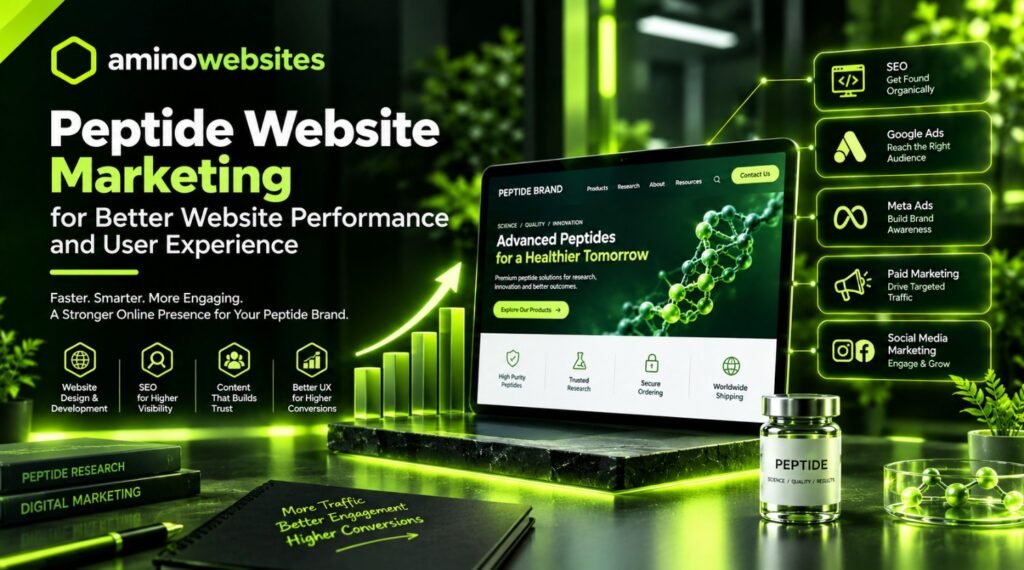
A peptide business needs more than a professional-looking website to stand out in a competitive digital market. It needs a clear message, a strong online presence, useful content, and a website experience that helps the right audience understand the brand. Without a coordinated approach, even a well-designed website can struggle to attract relevant visitors or generate meaningful inquiries.
Peptide website marketing brings together website design, search engine optimization, content development, user experience, and suitable promotional channels to help peptide brands strengthen their digital presence. Each element has a different purpose, but they work best when they support the same business goals.
At AminoWebsites, we help businesses develop and improve websites that support visibility, credibility, and long-term digital growth. Our approach to peptide website marketing focuses on connecting website performance with the needs of the intended audience rather than treating a website as a standalone online asset.
Whether your business serves research-related markets or another eligible segment of the peptide industry, a thoughtful website marketing plan can help communicate your offering more clearly and create a stronger foundation for future growth.
Why Peptide Website Marketing Requires a Specialized Approach
The peptide industry has distinct marketing considerations. Businesses may need to communicate technical information, explain product categories, address audience questions, and meet specific legal or platform requirements.
Generic marketing techniques may not address these needs effectively. A specialized approach considers the company’s business model, intended audience, website structure, and the types of claims it can appropriately make.
Effective peptide website marketing begins with understanding what visitors need before they can evaluate a business.
Communicate Your Brand’s Purpose Clearly
Visitors should be able to understand what your company offers and who it serves without navigating several pages to find basic information.
Your homepage should communicate your brand’s purpose, highlight relevant offerings, and guide visitors toward useful resources or appropriate next steps. Service and product pages should provide more specific information that supports informed decisions.
Avoid vague claims or exaggerated promises. Clear, accurate messaging makes it easier for visitors to understand your business and evaluate whether it meets their needs.
Build a Website Around Your Audience
Different audiences have different expectations. A research-focused business may need clear product specifications, research-related information, and appropriate documentation. Another business may need a different content structure based on its legitimate product category and intended customers.
Organize the website around those needs instead of forcing every visitor through the same journey.
A well-planned website gives peptide website marketing a stronger foundation because its content, navigation, and conversion paths support the audience you want to reach.
Create an SEO-Friendly Website Structure
Search engine optimization helps search engines understand your website and can improve its ability to appear for relevant queries. For peptide businesses, SEO should be based on useful information, appropriate keyword targeting, and a technically sound website.
Map Keywords to Relevant Pages
Keyword mapping helps assign a clear purpose to each important page. Instead of targeting every peptide-related keyword on the homepage, organize keywords according to search intent.
For example, a dedicated service page may target website development, while educational articles can answer questions about website functionality, search visibility, or digital marketing.
Use peptide website marketing as the primary topic for this article and related supporting content where appropriate. Avoid publishing multiple pages that offer nearly identical information simply to target minor keyword variations.
A useful keyword plan can include:
- Primary keywords that describe your main service or topic.
- Secondary keywords that provide relevant supporting context.
- Informational keywords that reflect audience questions.
- Commercial keywords that indicate interest in a service.
- Related terms that help explain the topic naturally.
The goal is to create relevant, useful pages rather than repeat the same phrases unnaturally.
Improve On-Page SEO
Review title tags, meta descriptions, heading structure, internal links, image alt text, and page content. Each page should have a descriptive title and a clear topic.
Use internal links to connect relevant blog posts with existing service pages. This helps visitors discover related information and gives search engines additional context about the relationship between pages.
Avoid keyword stuffing. Search terms should fit naturally into the content and accurately describe what the page provides.
Resolve Technical SEO Problems
Technical problems can interfere with crawling, indexing, and user experience. Review your website for broken links, incorrect redirects, duplicate URLs, sitemap errors, and pages that should not be indexed.
Check mobile usability and page speed as well. Visitors may leave if a page loads slowly or important information is difficult to access.
These improvements support peptide website marketing by helping search engines access relevant content and giving visitors a more dependable website experience.
Design Landing Pages That Support Conversions
A website may attract relevant visitors without generating the inquiries or actions the business expects. In many cases, the issue is not simply traffic volume. Visitors may struggle to understand the offering, find supporting information, or determine what to do next.
Landing pages should make the decision process easier.
Explain Benefits Without Overpromising
Use a clear headline, a concise explanation of the offering, relevant supporting details, and an appropriate call to action.
For a website development service, for example, the page might explain how a structured website can improve navigation, communicate product information, and support search visibility.
Avoid unsupported medical, scientific, or commercial claims. Product and service descriptions should reflect what the business can substantiate.
Make Important Information Easy to Find
Visitors should not have to search extensively for contact details, company information, policies, or relevant product documentation.
Depending on the business model, useful website elements may include:
- Clear product or service descriptions.
- Company background and contact information.
- Relevant quality or compliance documentation.
- Privacy and other applicable policies.
- FAQs addressing common audience concerns.
- Accessible inquiry forms and clear next steps.
The right elements depend on the website’s purpose and applicable requirements.
A well-organized landing page strengthens peptide website marketing by connecting a visitor’s initial interest with relevant information and an appropriate action.
Use Content Marketing to Build Search Visibility
Content marketing helps businesses answer audience questions, explain their expertise, and create additional entry points into the website.
For peptide companies, content should be relevant to the business’s legitimate activities and provide accurate information rather than relying on sensational claims.
Develop Helpful Blog Content
Build a content plan around the questions your audience asks before choosing a supplier, evaluating a business, or contacting a service provider.
Depending on the website, suitable topics might cover website functionality, product information standards, digital visibility, ecommerce usability, or general industry education.
Each article should have a defined purpose and provide information that is useful beyond inserting keywords.
A supporting blog strategy can expand peptide website marketing by helping the website address more relevant searches while directing interested readers to appropriate service or product pages.
Connect Blog Posts to Service Pages
Publishing content without internal links can make it harder for visitors to move from informational articles to relevant services.
Link to existing service pages when the connection is useful. Use descriptive anchor text that accurately represents the destination, and avoid forcing promotional links into unrelated paragraphs.
This creates a more coherent user journey and helps your website communicate how its different pages relate to one another.
Integrate Social Media Marketing With Your Website
Social media can help businesses maintain brand visibility, distribute useful content, and communicate with audiences through appropriate channels.
However, social media should support the website rather than replace it. The website remains an important destination where visitors can find detailed information about the company and its offerings.
Maintain Consistent Brand Messaging
Use consistent brand language, accurate descriptions, and relevant visual elements across your website and social media profiles.
Social media marketing may involve sharing educational content, company updates, website resources, and relevant announcements. The specific approach should reflect your audience and the rules of each platform.
For eligible businesses, peptide social media marketing can complement website content by helping interested audiences discover relevant resources and understand the brand’s focus.
Direct Visitors to Relevant Website Pages
Instead of sending every social media visitor to the homepage, link to the most relevant page for the content being shared.
An educational post might link to a detailed article, while a post introducing an eligible service could link to its dedicated service page.
This creates a clearer path between discovery and further engagement.
Remember that social media platforms may impose restrictions on peptide-related products, claims, and promotional content. Review current policies before publishing promotional material or running campaigns.
Evaluate Paid Advertising Opportunities Carefully
Paid advertising can provide additional visibility, but peptide-related businesses must evaluate eligibility before investing in campaigns.
Platform rules can vary according to the product, intended use, business model, landing page, and advertising claims. A campaign that is appropriate for one business may not be permitted for another.
Understand Peptide Google Ads Requirements
Peptide Google Ads campaigns require careful policy review. Google Ads restricts certain healthcare-related products and claims, and eligibility depends on the applicable policies and the specific offering.
Before launching a campaign, verify whether the product, destination website, account, and proposed messaging are eligible. Do not assume that changing ad copy will make a restricted product permissible.
Where advertising is allowed, align the keywords, ad message, and landing page. Monitor relevant outcomes and make decisions based on reliable performance data.
Review Peptide Meta Ads Eligibility
Peptide Meta Ads also require a review of the relevant advertising policies and applicable restrictions.
Businesses should not assume that a product is eligible merely because similar advertisements appear online. Evaluate the current rules, the intended audience, the product category, and any claims made in the creative or landing page.
For permitted campaigns, use accurate messaging, relevant landing pages, and clear objectives. Avoid unsupported health claims or guarantees.
Build a Sustainable Advertising Plan
Peptide paid marketing should be considered as one part of a broader digital plan rather than the only source of traffic.
When peptide paid advertising is permitted, establish measurable goals, monitor campaign performance, and ensure that the destination page provides accurate information.
Advertising for peptide brands should never rely on misleading claims or attempt to bypass platform restrictions. In some cases, businesses may need to prioritize organic search, suitable educational content, and other permitted channels instead.
A specialized review of the available options can help businesses choose an appropriate approach without assuming that every advertising platform is suitable.
Strengthen Your Brand Through Peptide Digital Marketing
A website is more effective when its design, content, search visibility, and promotional activity support a consistent brand identity.
Peptide digital marketing can include SEO, website improvements, educational content, appropriate social media activity, email communication, and eligible advertising. The combination should reflect the business’s objectives and the requirements of its market.
Maintain a Consistent Brand Experience
Your website should feel consistent with your other digital channels. Use recognizable brand elements, clear messaging, and accurate information across relevant touchpoints.
Inconsistency can make a business harder to recognize and may leave visitors uncertain about its services or credibility.
Review your homepage, product pages, service pages, blog content, and social profiles together. Identify differences in messaging and update them where necessary.
Use Email Marketing Where Appropriate
Email can help businesses communicate with subscribers who have consented to receive messages. Depending on the business model, emails may share useful content, company updates, service information, or relevant announcements.
Keep communications accurate and useful, and follow applicable privacy and marketing requirements.
Email should support the website experience by directing readers to relevant pages rather than sending generic messages without a clear purpose.
Measure the Performance of Your Website Marketing
A website marketing plan should be evaluated using meaningful indicators rather than relying on traffic alone.
For example, an increase in website visitors does not automatically mean that more qualified people are finding the business. Review both visibility and the actions visitors take after arriving.
Track Organic Search Performance
Use Google Search Console to monitor impressions, clicks, click-through rate, average position, and the queries that generate visibility.
Identify pages that are receiving impressions but few clicks, then assess whether their titles and descriptions accurately represent the content and match search intent.
Review important landing pages to understand whether they attract relevant queries and connect visitors with the right next step.
Monitor Engagement and Conversions
Use appropriate analytics tools to evaluate traffic sources, important page visits, inquiry form submissions, and other meaningful interactions.
If a page receives traffic but generates few inquiries, review the page content, audience relevance, user experience, and call to action before deciding that more traffic is the solution.
Track performance consistently and make changes based on evidence. This helps you refine peptide website marketing over time rather than relying on assumptions.
Why Choose AminoWebsites for Peptide Website Marketing?
AminoWebsites helps businesses create and improve digital experiences through website design and development, SEO, and ecommerce website solutions.
For peptide businesses, a website should do more than display products or services. It should communicate the company’s purpose, organize relevant information, provide a dependable user experience, and support appropriate marketing activities.
Our approach to peptide website marketing considers how website structure, search visibility, content, and conversion paths work together. We focus on building a practical foundation that businesses can improve as their needs evolve.
Depending on your requirements, our services can help you:
- Improve website structure and navigation.
- Develop clearer service and product pages.
- Strengthen on-page and technical SEO.
- Create a more consistent brand experience.
- Improve the user journey toward relevant inquiries.
- Support appropriate digital marketing activities through a well-organized website.
We also recognize that peptide businesses may face product-specific and platform-specific restrictions. Website content and marketing recommendations should reflect applicable requirements instead of assuming that every promotional method is available.
By connecting website development with practical marketing considerations, AminoWebsites helps businesses build a digital foundation designed around their audience and objectives.
Get a Free Consultation
Is your peptide business ready to improve its website and strengthen its online presence?
AminoWebsites can help you assess your current website, identify opportunities for improvement, and develop a practical plan for better usability, search visibility, and brand communication.
Get a Free Consultation with AminoWebsites to discuss your website goals and explore how a more structured digital experience can support your business.
Build a website that communicates your value clearly, serves your audience effectively, and provides a stronger foundation for future growth.
Frequently Asked Questions
1. What is peptide website marketing?
Peptide website marketing involves improving a peptide business’s website and its supporting digital channels to strengthen online visibility, communicate relevant information, and encourage appropriate visitor actions. It can include SEO, content marketing, website improvements, and eligible promotional activities.
2. Why is SEO important for peptide websites?
SEO helps search engines understand a website’s content and can improve its visibility for relevant searches. Useful content, appropriate keyword targeting, internal links, and sound technical SEO can support a stronger organic search presence.
3. Can peptide businesses advertise through Google Ads and Meta Ads?
Eligibility depends on the specific product, business model, claims, destination website, and current platform policies. Certain products and claims may be restricted, so businesses should review the applicable rules before launching campaigns.
4. How can a peptide website generate more qualified inquiries?
A website can support more qualified inquiries through clear messaging, relevant service pages, accessible contact information, helpful content, strong navigation, and appropriate calls to action. Performance tracking helps identify which improvements are most useful.
5. What services can support peptide digital marketing?
Depending on the business’s needs, peptide digital marketing may involve website design and development, SEO, content marketing, social media activity, email marketing, and eligible paid advertising. The right combination depends on the target audience and applicable requirements.
6. How long does peptide website marketing take to show results?
The timeline varies according to competition, website condition, search demand, content quality, and the work being implemented. Technical improvements may address existing issues relatively quickly, while organic search visibility generally requires ongoing effort and evaluation.
7. Why should a peptide business work with a specialized website agency?
A specialized agency can help align website structure, content, user experience, and SEO with the needs of the intended audience. It can also help identify industry-specific considerations that should be addressed before implementing promotional activities.