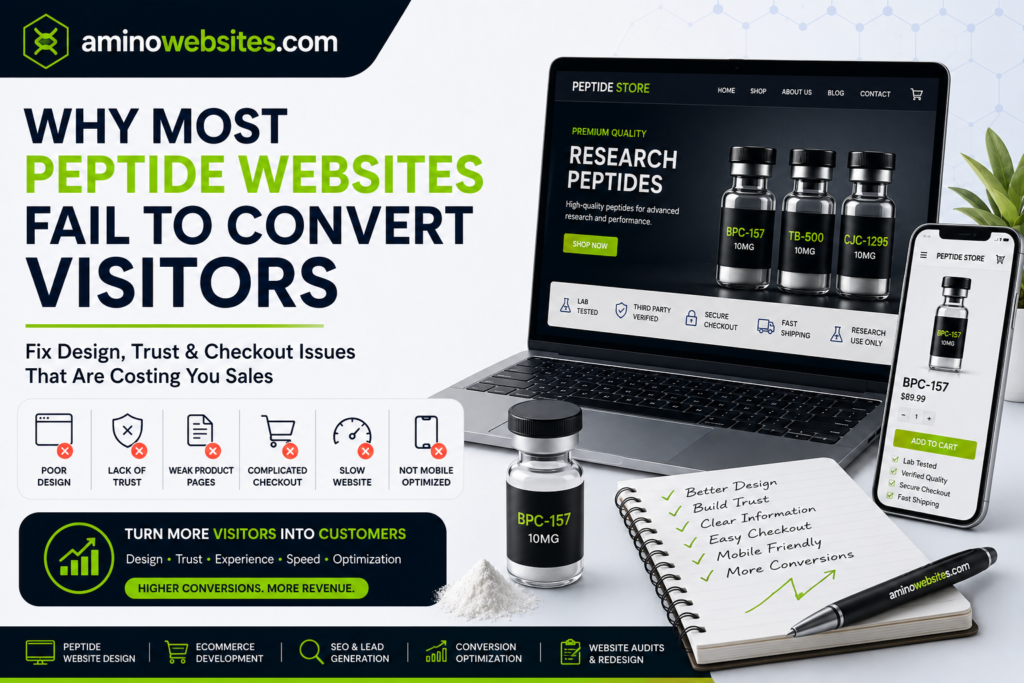
Peptide websites fail to convert for many reasons, but lack of traffic is not always the biggest problem.
A peptide company may already be attracting visitors through Google, social media, referrals, educational content, or paid campaigns. People arrive, browse several pages, look at products, and then leave without completing an order or contacting the company.
When that happens consistently, sending more visitors to the same website may simply increase the number of people experiencing the same problems.
The real issue is often what happens after someone arrives. Product information may feel incomplete. Testing documents may be difficult to find. Navigation may create confusion. Mobile pages may load slowly. Checkout may introduce unnecessary friction.
This guide explains why peptide websites fail to convert and which areas deserve attention first.
Insert the Table of Contents by Rank Math block here. Delete this instruction after adding the block.
Why Peptide Websites Fail to Convert Even With Traffic
Traffic creates an opportunity. It does not guarantee a sale.
The website still needs to help visitors understand the business, evaluate the products, find supporting information, and move toward the next step.
For peptide companies, that process can involve more research than it does for an ordinary ecommerce purchase.
Visitors may examine:
- Product descriptions
- Technical specifications
- Testing information
- Certificates of Analysis
- Batch details
- Shipping information
- Business policies
- Contact options
- Website quality
- Checkout experience
When important information is missing or difficult to locate, hesitation grows.
Understanding this customer journey is the foundation of stronger peptide website conversion.
For a detailed step by step approach, read our peptide website conversion optimization guide.
1. The First Screen Does Not Explain Enough
Visitors should understand the business quickly after landing on the website.
Many peptide websites open with a large scientific image and a general headline about innovation, quality, or research.
It may look professional, but the visitor is still left asking what the company actually offers.
The first screen should make four things clear:
- What the business provides
- Who it serves
- Why the company is credible
- What the visitor should do next
Avoid placing several competing calls to action in the same section.
A clear product browsing button may be enough for an ecommerce homepage. A service website may instead guide visitors toward a consultation or website audit.
Clarity usually helps more than clever wording.
2. Trust Signals Are Difficult to Find
One reason peptide websites fail to convert is that credibility information is often separated from the pages where visitors actually make decisions.
For example, a product page may discuss quality while the relevant testing document is hidden in a separate document library.
A stronger experience places useful trust information closer to the decision.
Depending on the business, this may include:
- Current Certificates of Analysis
- Matching batch information
- Independent laboratory information
- Clear company details
- Contact information
- Shipping policies
- Return information
- Privacy information
- Terms and conditions
- Professional product images
Avoid relying only on badges saying premium, trusted, secure, or highest quality.
Specific information gives visitors something meaningful to evaluate.
How Trust Signals Improve Peptide Website Conversion
Trust signals work best when they answer questions instead of simply decorating the page.
For example, a Certificate of Analysis connected directly to the relevant product tells the visitor more than a generic quality badge.
The same applies to shipping information, company policies, and customer support.
The goal is to reduce the amount of searching a visitor must do before feeling comfortable with the next step.
3. Product Pages Create More Questions Than Answers
Product pages are among the most important pages on a peptide ecommerce website.
A basic page containing a title, image, price, and Add to Cart button may not provide enough information.
A stronger product page should make relevant information easy to review.
This may include:
- Product name
- Quantity and form
- Original product description
- Technical specifications
- Storage information
- Current batch details
- Testing documentation
- Price
- Availability
- Product questions
- Clear purchasing options
Avoid copying one description across several products.
Each page should explain what makes that particular product different.
Where relevant, testing documents should also connect clearly with the batch being displayed.
For broader guidance on product structure, store development, SEO, and checkout, read our complete peptide ecommerce guide.
4. Navigation Makes Visitors Work Too Hard
Complicated navigation creates friction before visitors even reach a product.
People should not need to understand your internal company structure to understand the menu.
Use familiar labels.
A simple menu may include:
- Products
- Quality and Testing
- About
- Blog
- Frequently Asked Questions
- Contact
Product categories can be organized underneath the main product section.
Avoid putting every page in the main navigation.
Google also recommends building clear ecommerce navigation where categories and products can be reached through crawlable links. You can review the official Google ecommerce site structure guidance.
Keep this external link as a normal follow link in WordPress.
Clear navigation helps visitors and search engines understand how the website is organized.
5. Mobile Visitors Receive a Worse Experience
A website can perform well on desktop while creating problems on a phone.
This matters because mobile visitors need to complete the same important actions.
They should be able to:
- Browse products
- Read specifications
- Open testing documents
- Use navigation
- Select product options
- Complete forms
- Add products to the cart
- Finish checkout
Common mobile problems include oversized headings, tiny buttons, slow images, difficult menus, wide tables, and popups that cover important content.
Peptide websites fail to convert when mobile visitors constantly need to zoom, scroll sideways, or close overlays before reaching useful information.
6. Website Speed Interrupts the Buying Journey
Speed is part of user experience.
Large images, heavy scripts, unnecessary plugins, excessive animation, and weak hosting can make important pages slow to use.
Visitors should not have to wait for large design elements before they can access product information.
Google’s Core Web Vitals guidance provides useful information about loading performance, responsiveness, and visual stability.
Keep this link as a normal follow external link.
Useful performance improvements may include:
- Compressing images
- Using modern image formats
- Removing unnecessary plugins
- Reducing unused scripts
- Improving caching
- Choosing suitable hosting
- Testing important pages on mobile
Do not install several optimization plugins that perform the same tasks. This can create new problems instead of improving performance.
7. Checkout Creates Unnecessary Friction
A customer who reaches checkout has already completed most of the journey.
They found the website, reviewed a product, considered the information, and added something to the cart.
The final steps should feel predictable.
Checkout should clearly show:
- Product details
- Quantity
- Price
- Shipping information
- Payment options
- Order summary
- Support information
Remove unnecessary fields when they are not required for the transaction or another legitimate business need.
Error messages should also clearly explain what needs to be corrected.
Guest checkout may simplify the process where an account is not necessary.
Peptide checkout optimization is particularly important because these visitors already demonstrate stronger purchase intent.
8. Marketing Campaigns Lead to the Wrong Pages
Sometimes the website itself is not the only problem.
A campaign may promise one thing and then send visitors to a generic homepage.
For example, an advertisement focused on a specific product category should ideally lead to a relevant category or landing page rather than making the visitor search from the homepage.
A strong customer journey connects:
- Search intent
- Advertisement message
- Landing page headline
- Product or service information
- Supporting evidence
- Call to action
Peptide marketing works better when the visitor sees a clear continuation of the message that brought them to the website.
The same principle applies to SEO.
An educational search should lead to useful educational content. A commercial search should lead to a page that helps the visitor evaluate the relevant product or service.
9. Website Decisions Are Based on Guesswork
Changing colours, adding new buttons, or rebuilding sections without data can consume time without fixing the actual problem.
Analytics can show where visitors are struggling.
Review actions such as:
- Product page views
- Testing document clicks
- Add to Cart activity
- Checkout starts
- Completed orders
- Form submissions
- Important exit pages
- Mobile performance
Google Analytics supports ecommerce event tracking for actions throughout the purchasing journey. The official Google Analytics ecommerce guidance explains how these events can be measured.
Again, leave this as a normal follow link.
A high traffic product page with little cart activity may have an information or trust problem.
A large drop during checkout may point toward shipping, payment, form, or usability friction.
A mobile page that performs much worse than desktop may require a closer usability review.
When a Peptide Website Redesign Makes Sense
Not every conversion problem requires a complete redesign.
Sometimes targeted improvements are enough.
You may be able to improve performance by updating:
- Product descriptions
- Testing document placement
- Mobile layouts
- Calls to action
- Navigation
- Page speed
- Checkout fields
- Internal links
A larger redesign becomes more reasonable when the existing website structure prevents these improvements.
Old templates may not support detailed product information. Navigation may have become confusing as the catalogue expanded. The mobile layout may also have fundamental problems that are difficult to fix individually.
Start with a website audit before committing to a full redesign.
An industry aware website partner can help identify whether the problem requires targeted improvements or a wider structural change.
Why Peptide Website Conversion Should Be Ongoing
A website is not finished simply because it has launched.
Products change. New content is published. Customer questions evolve. Traffic sources change. Search behavior changes.
The website should develop alongside the business.
Review important pages regularly.
Check whether:
- Information is still accurate
- Testing documents are current
- Links still work
- Mobile pages remain usable
- Checkout works properly
- Calls to action are clear
- Important pages receive relevant traffic
Peptide websites fail to convert when these small issues accumulate without being noticed.
Regular reviews make problems easier to identify before they affect a large portion of visitors.
Common Peptide Website Conversion Mistakes
Several mistakes appear repeatedly across underperforming websites.
Avoid:
- Sending more traffic to weak landing pages
- Using copied product descriptions
- Hiding important documents
- Filling pages with generic trust badges
- Using too many calls to action
- Ignoring mobile checkout
- Making changes without analytics
- Installing unnecessary plugins
- Leaving outdated information online
- Changing several major elements at the same time
A useful website change should solve a specific visitor problem.
Before changing something, ask one simple question:
What uncertainty or obstacle does this remove?
If there is no clear answer, the change may not improve conversions.
Frequently Asked Questions
Why Do Peptide Websites Fail to Convert?
Peptide websites fail to convert when visitors encounter missing information, weak trust signals, confusing navigation, slow mobile pages, unclear product descriptions, or difficult checkout experiences.
The exact cause differs between websites, which is why an audit should come before major changes.
Can Better Peptide Website Design Improve Sales?
Better design can support conversions when it improves clarity, credibility, navigation, mobile usability, and access to important information.
Visual appearance alone is rarely enough.
What Should I Fix First?
Start with pages that already receive meaningful traffic.
Review the headline, product information, trust signals, mobile performance, calls to action, and checkout journey.
Fix the clearest source of hesitation first.
How Can I Improve My Peptide Ecommerce Conversion Rate?
Improve product information, simplify navigation, make supporting documents easy to access, improve page speed, test mobile usability, and remove unnecessary checkout friction.
Measure the results rather than assuming each change worked.
Do I Need a Complete Website Redesign?
Not always.
A redesign makes sense when the underlying templates, navigation, product structure, mobile design, or checkout prevent targeted improvements.
What Is Peptide Website Conversion Optimization?
Peptide website conversion optimization is the process of improving the customer journey so more relevant visitors complete meaningful actions.
For a detailed process, read our peptide website conversion optimization guide.
Final Thoughts
Understanding why peptide websites fail to convert begins with looking beyond traffic.
The website needs to help visitors understand the business, evaluate product information, find supporting evidence, navigate easily, and complete the next step without unnecessary friction.
More advertising cannot compensate for a confusing product page or difficult checkout.
Start by viewing your website from the perspective of a cautious first time visitor.
Review your headline, navigation, product pages, trust signals, testing information, mobile experience, and checkout.
Then continue with our Peptide Website Conversion Optimization guide for a more detailed improvement process.
If you want to discuss your website, customer journey, conversion problems, and growth opportunities, book a 30 Minute Discovery Call.
Educational Disclaimer
This article is provided for general informational purposes only. It does not constitute medical, legal, regulatory, payment processing, or compliance advice. Businesses should seek appropriate professional advice regarding requirements that apply to their products, platforms, marketing, and jurisdiction.

