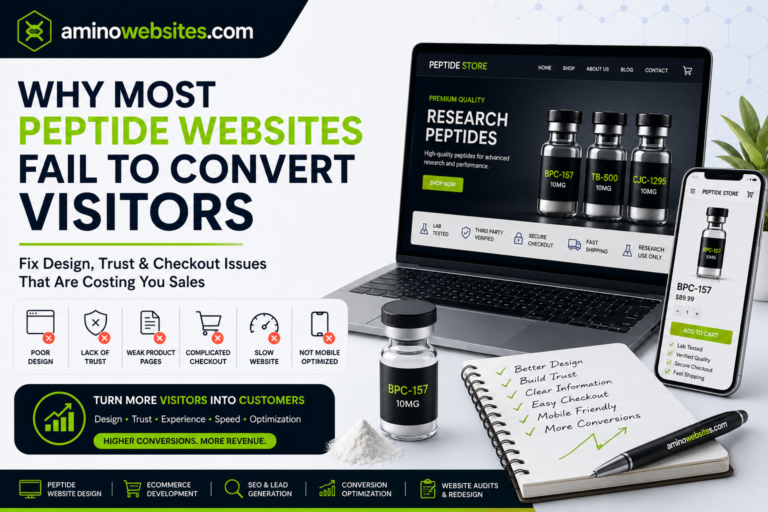
Selling peptides online requires more than attractive product images and a prominent Add to Cart button.
Peptide buyers often arrive with specific questions. They want to know what the product contains, how its purity was tested, whether the laboratory report matches the available batch, and how the compound should be stored.
When this information is difficult to find, even an interested buyer may leave the website.
That is why product-page structure should be a central part of your peptide marketing strategy. A well-designed page does not simply promote the product. It gives visitors the evidence, clarity, and confidence they need to continue.
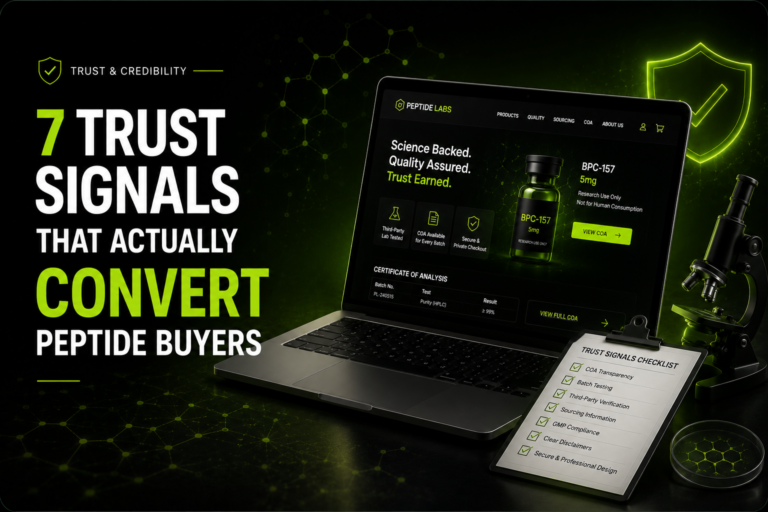
This article expands on the trust principles covered in our main guide, 7 Trust Signals That Actually Convert Peptide Buyers.
Read the complete peptide buyer trust guide
Why Peptide Product Pages Need a Different Structure
A generic ecommerce product page may work for clothing, household products, or accessories. It usually includes a title, a few images, a short description, a price, and a purchase button.
That structure is often too limited for a research peptide website.
People comparing peptides may want to review:
- Compound identity
- Amino acid sequence
- Molecular weight
- Product quantity
- Purity percentage
- Batch or lot number
- Testing method
- Certificate of Analysis
- Third-party laboratory information
- Storage requirements
- Product classification
- Research-use language
When these details are missing, the page feels incomplete.
A professional peptide ecommerce website should make technical information easy to understand without overwhelming the visitor. The goal is not to fill the page with scientific language. The goal is to organize the information so that buyers can quickly find what matters to them.
1. Begin With a Clear Product Summary
The top of the page should answer the visitor’s most immediate questions.
Instead of opening with a long marketing paragraph, provide a simple summary that includes:
- The compound name
- The quantity offered
- The stated purity
- The intended classification
- Access to the current laboratory report
A clear product summary helps buyers understand what they are viewing before they scroll deeper into the page.
This is also valuable for peptide SEO because search engines need clear information about the page. Product titles, introductory copy, headings, image descriptions, and structured data should all describe the same compound accurately.
Avoid stuffing the introduction with keywords. A natural sentence using terms such as research peptides, peptide products, or laboratory-tested peptides is more useful than repeating the same phrase several times.
2. Make the Certificate of Analysis Easy to Find
A Certificate of Analysis is one of the strongest trust signals a peptide company can provide.
However, simply having a COA somewhere on the website is not enough.
Buyers should not have to search through a document library, contact customer support, or visit several pages to find it. The laboratory report should be linked directly from the relevant product page.
A strong COA section should clearly show:
- The batch or lot number
- The testing date
- The name of the laboratory
- The tested purity
- The analytical method used
- A clear button to view or download the report
The COA should also match the batch currently available for purchase.
Displaying an old or generic report may create more doubt than confidence. Buyers want to know that the documentation relates to the product they are considering, not a previous batch from several months ago.
From a peptide marketing perspective, this level of transparency can become a competitive advantage. Rather than making broad quality claims, the company gives visitors something they can verify themselves.
3. Connect Batch Numbers to Laboratory Reports
Batch traceability turns a laboratory document into meaningful proof.
Suppose a product page displays one batch number while the linked COA shows another. Even when the difference is accidental, it can make the website appear poorly managed.
Your product-page system should connect each available batch with its matching test report.
This can be shown through a simple section containing:
Current batch: ABC123
Testing completed: Month and year
Purity: Stated percentage
Laboratory: Independent laboratory name
Report: View Certificate of Analysis
This information should be updated whenever a new batch is added.
For growing peptide businesses, the process should be built into the website’s backend. Staff should be able to update the batch number, test date, purity result, and COA file without rebuilding the page.
This is one reason specialized peptide website development matters. Trust features need to work as part of the product system, not as manually added content that becomes outdated.
4. Present Technical Specifications Clearly
Peptide buyers often look for technical details, but those details should not appear as one dense block of text.
Use a clearly labeled specifications section for information such as:
- Compound name
- Amino acid sequence
- Molecular formula
- Molecular weight
- Purity
- Physical form
- Quantity
- Storage conditions
- Testing method
- Batch number
A table may work well for this information because it allows buyers to scan the details quickly.
The page should also explain technical terms when necessary. Not every visitor will immediately understand the difference between identity testing, purity testing, and quantity verification.
Clear explanations help new visitors learn while still providing experienced buyers with the data they expect.
This balance is important for both user experience and peptide content marketing. The website should demonstrate expertise without making the reader feel excluded.
5. Explain Third Party Laboratory Testing
The phrase “lab tested” is commonly used, but it can be too vague to build meaningful trust.
Visitors may want to know:
- Was the testing completed internally or independently?
- Which laboratory performed it?
- What method was used?
- When was the testing completed?
- Does the report match the current batch?
A third party laboratory section can answer these questions.
There is no need to make the explanation overly promotional. A simple statement describing the testing process can be more persuasive than a large badge claiming premium quality.
For example:
Each available batch is submitted to an independent laboratory for identity and purity analysis. The corresponding report is linked directly on the product page.
Specific language supports credibility because it explains what the company actually does.
This type of transparency can also strengthen a broader peptide marketing strategy. Laboratory information can support product pages, quality-control pages, educational blogs, email campaigns, and customer service responses.
6. Use Accurate and Consistent Research Language
The language used on a peptide product page affects trust, compliance awareness, and brand positioning.
If the page describes the product as a research compound but then makes unsupported personal health promises, the message becomes inconsistent.
Buyers who understand the industry may view this as a warning sign.
The product page, checkout, terms, educational content, advertisements, and social media posts should all follow the same classification and communication standards.
Responsible copy should explain:
- What the compound is
- How it is discussed in research
- What technical information is available
- How the product is tested
- How it should be handled or stored
- What its intended classification is
It should avoid presenting research observations as guaranteed results.
Careful language does not make the page less persuasive. For knowledgeable peptide buyers, restraint often builds more credibility than exaggerated copy.
7. Add Storage and Handling Information
Storage instructions should not be hidden in a frequently asked questions page or provided only after purchase.
Visitors may want to know how the product should be handled before placing an order.
A storage section may address:
- Recommended temperature
- Protection from light
- Moisture considerations
- Whether refrigeration is required
- Instructions for unopened products
- General handling precautions
The information should be specific to the product and based on the company’s documented requirements.
Avoid adding vague or copied instructions that may not apply to every compound.
Clear storage information supports customer confidence and reduces avoidable support questions. It also shows that the company understands the products it sells.
8. Answer Questions Directly on the Product Page
Frequently asked questions can remove uncertainty without making the main description too long.
Useful questions may include:
Is a Certificate of Analysis available?
Explain where the report can be found and whether it matches the current batch.
Who performs the testing?
State whether testing is conducted by an independent laboratory.
What does the purity percentage mean?
Provide a short, understandable explanation rather than assuming every buyer knows.
How should the product be stored?
Summarize the main storage conditions and link to more detailed guidance when needed.
Is the product intended for research use?
Use language that accurately reflects the company’s product classification and policies.
FAQs can also support peptide SEO services by addressing the detailed questions people type into search engines.
However, the answers should be written for people first. Do not repeat keywords unnaturally or create questions that no real customer would ask.
9. Use Real Reviews Carefully
Reviews can support trust, but generic praise may not persuade technically informed buyers.
Comments such as “Amazing product” or “Best company ever” provide very little useful information. When every review sounds identical, visitors may question whether the feedback is authentic.
More credible reviews may mention:
- Order accuracy
- Packaging quality
- Shipping experience
- Customer support
- Ease of locating documentation
- Clear batch information
- Consistency between orders
Reviews should not make unsupported medical or therapeutic claims. Businesses should also avoid rewriting customer feedback so heavily that every review sounds like promotional copy.
Authenticity matters more than perfection.
A believable review section can support both conversion optimization and peptide brand marketing, but it should not replace laboratory documentation, product specifications, or clear company policies.
10. Make Trust Information Work on Mobile Devices
Many customers will first visit your website from a phone.
If the product specifications are unreadable, the COA button is difficult to find, or the page takes too long to load, visitors may leave before reviewing the information.
A mobile-friendly peptide product page should include:
- Readable text
- Clear section headings
- Easy-to-tap buttons
- Fast-loading images
- Accessible COA links
- Simple product options
- A visible purchase button
- Minimal unnecessary popups
Technical information may need to be displayed differently on smaller screens. Tables should not force users to drag the page sideways, and document links should open without breaking the shopping experience.
Mobile usability is an important part of peptide website design, search performance, and conversion optimization.
11. Avoid Overloading the Page With Trust Badges
Trust badges can be useful, but too many of them can make a website look less credible.
Generic icons claiming secure checkout, premium quality, fast shipping, guaranteed purity, and customer satisfaction do not provide the same value as verifiable information.
For peptide buyers, stronger trust signals include:
- A current COA
- Matching batch numbers
- Named third-party testing
- Accurate product specifications
- Clear shipping policies
- Accessible contact information
- Consistent product classification
- Professional website design
Use visual badges only when they represent something meaningful and can be supported by real information.
Specific proof will usually be more convincing than broad reassurance.
12. Connect Product Pages With Educational Content
A product page should provide essential information, but it does not need to explain every scientific concept in full.
Longer educational articles can support the product page by explaining topics such as:
- What peptides are
- How Certificates of Analysis work
- Why batch testing matters
- How peptide purity is evaluated
- The difference between identity and purity testing
- How research compounds should be stored
- What third-party laboratory verification means
Internal links allow interested visitors to learn more without overcrowding the purchasing page.
This also helps build topical authority for peptide SEO. Search engines can better understand the website when product pages, quality pages, and educational articles are clearly connected.
A strong content structure can attract people at different stages of the buying journey, from those learning about peptides to those comparing specific products.
How Product Pages Support Peptide Marketing
Your marketing campaigns may bring visitors to the website, but the product page must do the difficult work of turning attention into confidence.
SEO, paid advertising, social media, and email marketing become less effective when visitors land on pages that feel incomplete or untrustworthy.
High performing peptide marketing requires alignment between:
- Search intent
- Product information
- Laboratory documentation
- Brand positioning
- Website design
- Technical performance
- Trust signals
- Calls to action
The page should answer the buyer’s questions in a logical order.
Visitors should not have to choose between reading a long scientific essay and making a blind purchase. They should be able to review the most important details quickly and explore deeper information when needed.
Final Thoughts
Peptide buyers do not need more vague promises. They need clear, verifiable information.
A strong peptide product page brings together laboratory reports, batch traceability, technical specifications, careful research language, storage guidance, authentic reviews, and accessible policies.
These elements should be planned during the website development process rather than added after the store is complete.
When your product pages are structured around transparency, they can improve customer trust, strengthen your peptide marketing, and help your brand stand apart in a competitive market.
For a broader explanation of the evidence peptide buyers look for, read: