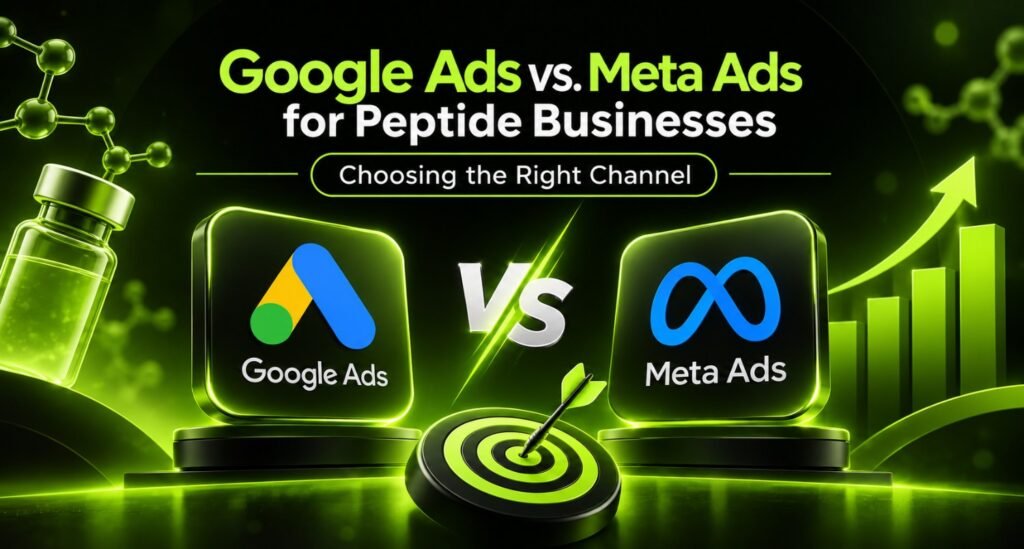
Choosing the right advertising platform can be challenging for peptide businesses. Google and Meta offer different ways to reach potential audiences, but their advertising models, targeting options, and policies are not the same. Before investing in paid campaigns, businesses need to understand how each platform works and whether their products and marketing approach meet the relevant advertising requirements.
The discussion around Google Ads vs Meta Ads for peptide businesses goes beyond deciding where to spend an advertising budget. It also involves building a website that communicates the business clearly, provides useful information, and creates a reliable experience for visitors. A strong website can support the overall marketing journey, whether visitors arrive through search advertising, social media, or organic search.
At AminoWebsites, we understand that a business website is an important part of its digital presence. From website design and development to SEO and ecommerce solutions, the right website foundation helps businesses present their brand professionally and make it easier for visitors to understand their services and navigate their online experience.
In this guide, we compare Google and Meta advertising, explain their different strengths, discuss important policy considerations, and explore how website quality supports a broader peptide advertising strategy.
Why Paid Advertising Matters for Peptide Businesses
Online visibility is important for businesses operating in competitive markets. Organic SEO can help websites attract visitors over time, but paid advertising offers another way to increase exposure when a campaign is eligible and properly configured.
A well-planned peptide paid advertising approach starts with understanding the audience, the business’s goals, and the platform’s restrictions. Businesses should not assume that every peptide-related product or service can be promoted through paid channels. Eligibility depends on the specific offering, advertising claims, landing-page content, target location, and platform policies.
For eligible businesses, paid campaigns may support objectives such as:
- Increasing awareness of a brand and its online presence.
- Reaching relevant audiences through appropriate advertising channels.
- Directing visitors to useful website resources.
- Supporting inquiries and other permitted conversion goals.
- Measuring how visitors interact with landing pages and website content.
However, paid traffic alone does not guarantee meaningful results. A website needs clear navigation, relevant content, accessible contact information, and a consistent brand experience. These elements help visitors understand what a business offers after clicking an advertisement.
Understanding Google Ads vs Meta Ads for peptide businesses is therefore an important starting point, but the website experience should be part of the decision.
Understanding Google Ads for Peptide Businesses
Google Ads is primarily associated with search-based advertising. It allows eligible advertisers to reach people through search results and other Google advertising placements. Search campaigns can be useful when an audience is actively looking for information, a particular service, or a business in a relevant category.
For businesses that meet Google’s requirements, Google advertising for peptide companies may offer opportunities to connect with users based on relevant search activity. However, the nature of the advertised product or service must be reviewed against Google’s healthcare and medicines policies, including its restrictions on certain unapproved substances and medical claims.
How Search Advertising Works
Search advertising generally connects advertisements with relevant search queries. For example, a user might search for a business category, a website service, or general educational information.
The potential value of search advertising comes from user intent. Someone actively searching for a relevant service may already have a specific need or question. This can make search advertising an interesting option for eligible businesses.
Google Ads strategies for peptide companies should begin with policy review rather than keyword selection alone. Advertisers need to assess whether the product, claims, keywords, and destination website are permitted.
The Importance of Landing Pages
A search advertisement is only one part of the visitor journey. Once someone clicks, the landing page becomes the next important interaction.
A useful landing page should:
- Explain the business and its offering clearly.
- Use accurate, relevant, and consistent information.
- Provide straightforward navigation.
- Include accessible contact information where appropriate.
- Work smoothly across desktop and mobile devices.
- Avoid unsupported claims and misleading statements.
A poorly structured landing page can create confusion even when an advertisement attracts relevant visitors. This is why website development and landing-page planning should be considered alongside any Google Ads strategy.
Understanding Meta Ads for Peptide Businesses
Meta Ads includes advertising across platforms such as Facebook and Instagram. Unlike search advertising, where users often express intent through a query, social advertising can introduce a brand to people while they are browsing content.
Facebook Ads for peptide brands and Instagram Ads for peptide businesses may appear attractive because of their visual formats and audience engagement features. However, businesses must first determine whether their specific products, services, and claims are eligible for promotion.
Meta’s advertising standards restrict the promotion of certain drugs, pharmaceuticals, and other substances considered unsafe. Advertisers should review the current requirements before preparing campaigns or promotional content.
How Social Media Advertising Works
Social advertising can help eligible businesses communicate their brand identity through different creative formats. Depending on the campaign objective and permitted targeting options, businesses may use images, videos, and other placements to introduce their services or share relevant information.
Meta Ads strategies for peptide brands should consider the relationship between the advertisement and the destination website. The message should be accurate and consistent, and the landing page should provide the information visitors expect.
A professional social media presence can also contribute to brand recognition. However, engagement, impressions, and clicks should not be treated as proof of business growth on their own.
The Role of Website Experience
Visitors who arrive from Facebook or Instagram need a clear next step. A website should make it easy to understand the brand, explore relevant information, and find appropriate contact options.
For example, a confusing navigation structure, inconsistent branding, slow-loading pages, or unclear service descriptions can weaken the visitor experience. A professionally developed website helps create a consistent connection between social media content and the business’s online presence.
Google Ads vs Meta Ads: Key Differences
When comparing Google Ads vs Meta Ads for peptide businesses, the most important difference is how people encounter advertisements.
Google is primarily associated with search intent, while Meta is often used to introduce brands and content through social platforms. Both channels have different strengths, but neither should be selected without considering advertising eligibility and the website experience.
| Comparison Factor | Google Ads | Meta Ads |
| Main environment | Google Search and other Google placements | Facebook, Instagram, and other Meta placements |
| Typical discovery method | Search queries and relevant placements | Social feeds, stories, reels, and other placements |
| Audience behavior | Users may be actively searching for information | Users may encounter a brand while browsing |
| Creative approach | Often text-led in search campaigns, with other formats available | Visual formats, videos, and social creative |
| Website role | Relevant landing pages support the search journey | Consistent destination pages support social discovery |
| Main consideration | Search relevance and policy eligibility | Creative suitability, audience rules, and policy eligibility |
These differences help explain why Google Ads vs Meta Ads for peptide businesses is not simply a comparison of clicks or advertising costs. The right channel depends on the business model, permitted promotional activity, audience needs, and marketing objectives.
Search Intent vs. Social Discovery
Google search campaigns can be relevant when users are actively looking for a permitted service or information. Meta advertising can introduce an eligible brand to audiences through social content.
This distinction is useful when considering Google Ads vs Facebook Ads. Search advertising often responds to an existing query, while social advertising can create awareness before a user actively searches for a business.
Neither approach automatically produces better results. Campaign performance depends on the audience, offer, creative quality, website, and measurement setup.
Audience Targeting and Customer Acquisition
Audience understanding is a central part of any peptide marketing strategy. Before choosing a platform, businesses should identify who they are trying to reach, what information those visitors need, and which actions are appropriate for the business.
Peptide audience targeting must also respect each platform’s rules. Advertisers should not assume that every targeting option is available for health-related or restricted product categories. Platform restrictions and local advertising requirements may affect what can be promoted and how audiences can be reached.
Build a Clear Audience Profile
A useful audience profile can include:
- The audience’s general interests and information needs.
- The type of business or service they are researching.
- Questions they may have before contacting a company.
- The website information they need to make an informed decision.
- The appropriate next step after visiting the website.
This information can guide content organization and website structure, even when certain paid advertising options are unavailable.
Make the Website Part of Customer Acquisition
Peptide customer acquisition should not be viewed only as an advertising activity. The website also influences how visitors understand a brand and whether they can find the information they need.
A clear homepage, well-organized service pages, relevant educational content, and accessible contact details can support a better experience. These elements are also important for organic search and direct website visits.
For businesses working on peptide brand awareness, consistent messaging across the website and other digital channels helps visitors recognize the business and understand its positioning.
Advertising Costs, Performance, and Campaign Measurement
Advertising costs can vary significantly between platforms, industries, locations, audiences, and campaign objectives. There is no universal rule that Google Ads is always more expensive than Meta Ads or that one platform delivers a lower cost per lead.
Before allocating a budget, businesses should understand what they are allowed to advertise and which campaign objectives are available to them. Advertising budget allocation should follow realistic business goals rather than assumptions about platform performance.
Metrics Worth Understanding
For eligible campaigns, useful performance indicators may include:
- Impressions: How often an advertisement is displayed.
- Clicks: How many times users interact with an advertisement.
- Click-through rate (CTR): The percentage of impressions that result in clicks.
- Cost per click (CPC): The average amount paid for a click.
- Conversion rate: The percentage of visitors who complete a defined action.
- Engagement: How users interact with permitted social content.
These metrics should be considered alongside website performance. A campaign can generate clicks without producing meaningful engagement or inquiries.
Why Website Analytics Matter
Digital advertising performance is easier to evaluate when website tracking is configured correctly. Businesses should understand how visitors arrive, which pages they view, and whether they complete relevant actions.
Tools such as Google Analytics 4 and Google Tag Manager can help businesses measure website activity when configured appropriately and used in accordance with applicable privacy requirements.
A useful reporting setup can help identify whether visitors are reaching the right pages, whether landing pages are performing as expected, and where improvements may be needed.
Advertising Restrictions for Peptide-Related Businesses
One of the most important considerations in Google Ads vs Meta Ads for peptide businesses is advertising eligibility.
Peptide-related businesses operate across different categories, and not every product or service is treated the same way by advertising platforms. Some offerings may fall under healthcare, pharmaceutical, unapproved substance, or other restricted-content rules.
Google’s healthcare and medicines policy addresses restricted drug terms, unapproved substances, prescription drug services, and speculative or experimental medical treatments. Certain content is prohibited, while other categories may be allowed only under specific conditions, locations, or certification requirements.
Meta also has advertising standards covering drugs, pharmaceuticals, and other potentially unsafe substances, products, or supplements. The platform may assess the specific product and promotional content under its applicable policies.
Businesses should review the current policies directly:
- Google Ads Healthcare and Medicines Policy
- Meta Advertising Standards
Review the Website Before Advertising
The destination website is part of the advertising review process. Businesses should pay attention to the accuracy of product and service descriptions, the claims made on landing pages, and the consistency between advertisements and website content.
A website review should consider:
- Whether product and service descriptions are accurate.
- Whether claims are supported and appropriately presented.
- Whether the landing page matches the advertisement.
- Whether required business and contact information is accessible.
- Whether the website provides a clear and professional user experience.
- Whether the content complies with applicable platform and local requirements.
A disclaimer or a change in wording does not automatically make a restricted product eligible for advertising. Businesses should not attempt to hide product information or bypass advertising review systems. Eligibility must be assessed honestly against the actual offering and destination website.
How to Choose the Right Paid Advertising Platform
The question of which advertising platform is better for peptide businesses does not have one answer. The decision should begin with the business’s objectives, the audience it wants to reach, and whether the specific offering is permitted on the platform.
When comparing Google Ads vs Meta Ads for peptide businesses, consider the following factors.
Start With Advertising Eligibility
Before planning a campaign, review the current Google and Meta policies. Identify the product or service category, relevant claims, target location, and any certification or authorization requirements.
If the proposed offering is prohibited, choosing another advertising format or adjusting the campaign budget will not solve the eligibility issue.
Understand Your Audience
Consider whether your intended audience is actively searching for relevant information or is more likely to encounter a business through social content.
This can help guide your wider content and website strategy, even if paid promotion is not available for a particular product or service.
Evaluate Your Website
Your website should communicate your business clearly and provide a straightforward visitor experience. Check page structure, navigation, loading performance, mobile usability, and contact options.
A professional website is useful beyond paid advertising. It can also support organic search, referrals, and direct traffic.
Define Realistic Goals
Decide what you want your digital presence to achieve. Goals may include increasing relevant website visits, improving brand recognition, providing useful information, or generating appropriate business inquiries.
The best peptide advertising strategy is one that connects realistic goals with compliant marketing activity and a website that supports the visitor journey.
Can Google Ads and Meta Ads Work Together?
For businesses with eligible offerings, Google and Meta can serve different roles within a broader digital marketing plan. Search advertising may connect with users who are actively looking for relevant information, while social content can help communicate brand identity and maintain an online presence.
However, using both platforms does not mean that a restricted product becomes eligible. Each campaign must independently meet the platform’s requirements.
A connected digital marketing approach can also include:
- Search engine optimization for relevant website content.
- Educational resources that address genuine audience questions.
- A consistent website design and brand identity.
- Clear service and contact pages.
- Website analytics and performance monitoring.
- Social media content that follows applicable platform standards.
Paid traffic for peptide businesses should never be the only measure of online growth. A website that provides a useful experience can support visitors from multiple channels and create a stronger foundation for long-term visibility.
How AminoWebsites Helps Build a Stronger Website Foundation
Advertising platforms may bring visitors to a website, but the website itself shapes their experience. A professional online presence helps businesses communicate their identity, organize information, and make their services easier to understand.
AminoWebsites supports businesses through website design and development, SEO, ecommerce solutions, and digital website services. Our focus is on building websites that combine professional presentation with practical functionality.
For peptide businesses, a well-planned website can provide a clearer structure for brand information, relevant resources, service details, and visitor inquiries. It can also support broader marketing efforts by creating a consistent experience across search, social media, and other digital channels.
Our website services can help businesses focus on important areas such as:
- Professional website design: Present your business with a consistent visual identity and clear page layouts.
- Website development: Build a functional website with organized navigation and a user-friendly structure.
- SEO: Improve website content and technical foundations to support organic search visibility.
- Ecommerce development: Create an organized online shopping experience where the business model and applicable requirements permit it.
- Website content structure: Make important business information easier for visitors to find and understand.
A website should do more than provide a destination for advertising clicks. It should communicate the business clearly, support user needs, and provide a reliable foundation for the wider digital presence.
Looking to improve your business website? Contact AminoWebsites for a free consultation and explore how professional website design, development, and SEO can support your online presence.
Building the Right Foundation for Long-Term Digital Growth
Google and Meta offer different advertising environments, but choosing between them requires more than comparing reach, costs, or engagement. Businesses need to understand platform eligibility, audience needs, marketing objectives, and the quality of their website.
The comparison of Google Ads vs Meta Ads for peptide businesses highlights why a connected approach matters. Advertising decisions should be based on current policies and realistic goals, while the website should provide a clear and professional experience for every visitor.
Whether your business is improving its website, strengthening organic visibility, or planning its wider digital presence, investing in a strong website foundation is an important step. AminoWebsites can help you build that foundation through professional website design, development, and SEO services.
Frequently Asked Questions
Is Google Ads or Meta Ads better for peptide businesses?
Neither platform is automatically better. The right option depends on the specific product or service, advertising eligibility, target audience, location, and business objectives. Some peptide-related offerings may not be eligible for promotion on either platform.
Can peptide businesses advertise on Google?
Eligibility depends on the product or service and Google’s healthcare and medicines policies. Google restricts certain unapproved substances, prescription drug terms, and experimental medical treatments. Businesses should review the current policy before planning campaigns.
Can peptide brands use Facebook and Instagram Ads?
Meta applies advertising standards to drugs, pharmaceuticals, and other potentially unsafe substances or products. Whether a particular peptide-related business can advertise depends on the offering and the applicable policies. Approval should not be assumed.
What is the main difference between Google Ads and Meta Ads?
Google Ads is strongly associated with search-based advertising, where users may be actively looking for information. Meta Ads primarily reaches people through social platforms such as Facebook and Instagram, where users may encounter brands while browsing content.
Why is website design important for paid advertising?
The website is where visitors learn more after clicking an advertisement. Clear navigation, relevant content, mobile usability, and accessible contact information can make the experience easier and help visitors understand the business.
Can SEO support peptide businesses if paid advertising is restricted?
Yes. SEO can help businesses improve the organic visibility of permitted website content and provide useful information for their audiences. SEO does not guarantee rankings or replace advertising-policy requirements, but it can form part of a broader digital presence.
What should a peptide business review before launching an advertising campaign?
Businesses should review platform policies, local regulations, product eligibility, advertising claims, landing-page content, target locations, and any required certifications or authorizations. They should also make sure their website provides accurate and consistent information.
How can AminoWebsites help peptide businesses?
AminoWebsites offers website design and development, SEO, and ecommerce solutions. These services can help businesses create a professional online presence, organize website content, and improve the overall experience for visitors.